Rosetta//Robotics In Development

Rosetta Robotics Adapter

A Safety Substrate for Vision-Language-Action Models

The Robotics adapter translates the universal stability equation into the forces governing physical AI. Lambda (Λ) becomes Motion Aggressiveness, roughly the velocity and optimization horizon of a proposed trajectory. Gamma (Γ) becomes Reachability Margin, the topological distance to a hard joint, a hard human, or the boundary of a safe goal.

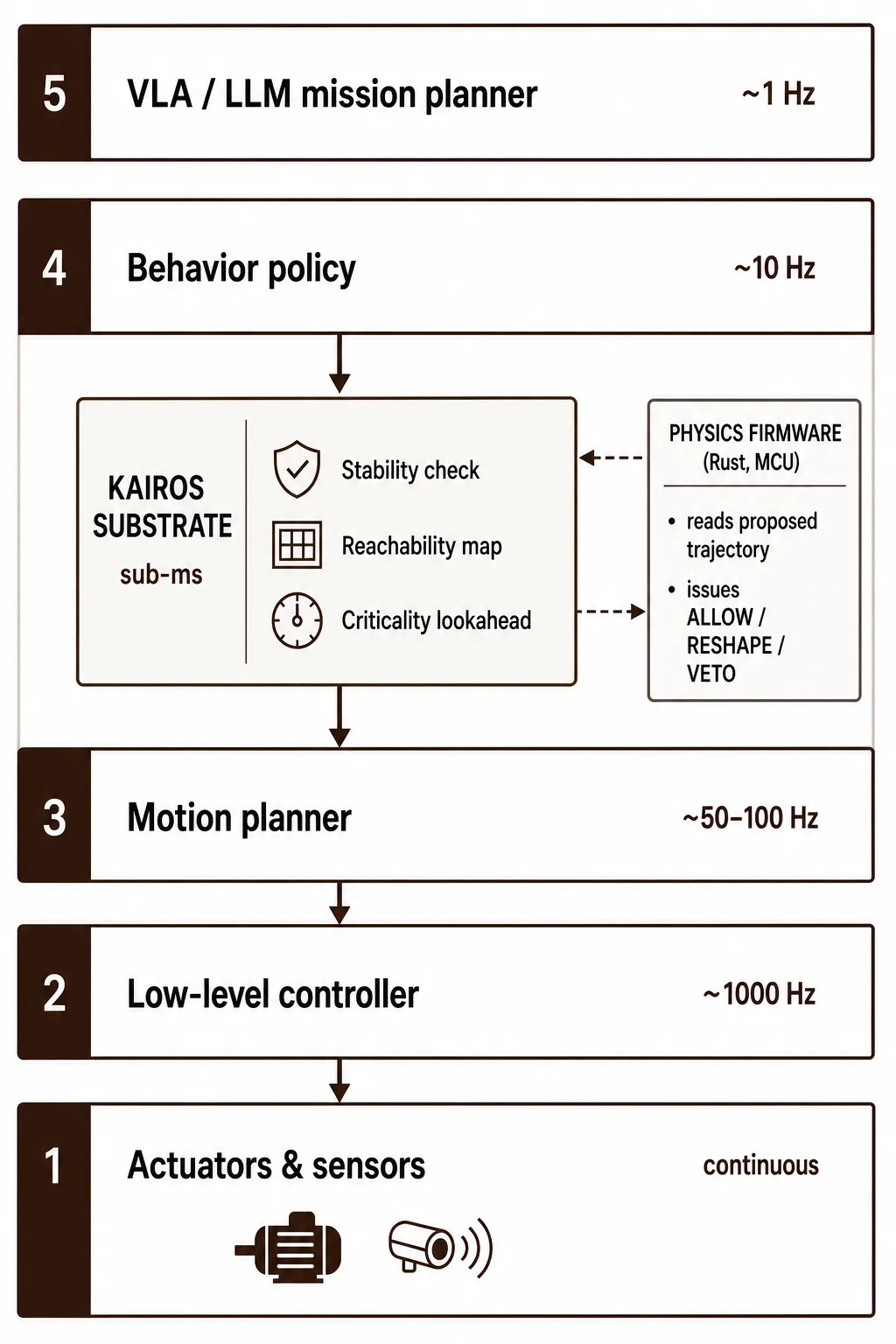
Substrate sits between the behavior policy and the motion planner. It evaluates every proposed action in under a millisecond and issues ALLOW, RESHAPE, or VETO on the same MCU as the low-level controller.

The Rosetta Robotics adapter is currently being developed.

Behavioral Alignment Does Not Transfer to Physics

Reinforcement learning from human feedback works for language because language has no physics. A model that says the wrong sentence apologizes and tries again. A robot that swings an arm through a human's shoulder ends in court.

A neural policy that usually avoids a human will, under distribution shift, do the unusual thing. A child wearing a costume the policy has never seen. A pose the teleoperation corpus never produced. The failure mode is structural: the policy returns its mean answer in a state where the safe set has already collapsed.

KAIROS Substrate sits outside the policy's cognition. It cannot be trained around because it is not in the training loop. It cannot be distribution-shifted because it does not classify states; it computes reachability.

The Stability Equation in Joint Space

Substrate models robot intent as a dynamical system governed by two forces.
Lambda (Λ) represents motion aggressiveness, roughly velocity multiplied by optimization horizon.
Gamma (Γ) represents the structural buffer to hard constraints.

The kernel computes a stability score at every control tick. The system intervenes when 𝒮 drops below the deployment floor. The decision follows the demands of the stability equation, not the output of a learned classifier.

S =
ΓA + ΓB
ΛA + ΛB

Equation: The stability score per agent

The kernel intervenes when the score drops below the threshold.

Sub-millisecond

Targeted at the 1 kHz control loop. No GC pauses, no allocator surprises.

Model-agnostic

The kernel evaluates trajectories independently of policy architecture.

GPU-free

CPU-only, embedded-target friendly. Runs on the safety MCU next to the motors.

Memory-safe

The core engine contains zero unsafe blocks.
Three Gates. Motion Read.

Every proposed motor command passes through a layered gate chain. Any gate will reject an action that violates structural integrity.

01

State Gate

Evaluates whether the current world state has already lost the safe set. If gamma falls below the agent's deployment floor, the kernel refuses further action and triggers safe pose.

02

Action Gate

Previews the proposed trajectory against the reachability field. Returns ALLOW, RESHAPE, or VETO before the motor command is issued.

03

Hazard Gate

Detects multi-agent paradoxes. Two drones converging on the same corridor trigger Dual Administrator Paradox. Each drone raises gamma; deconfliction is structural.

The Reversibility Horizon

Every physical action has a window before which it can be undone and after which it cannot. The kernel computes that boundary by backward dynamic programming.

01

Reachability Field

The set of future states still reachable from the current state. A safe trajectory preserves the set; an unsafe one collapses it. The answer is topological, not statistical.

02

Criticality Lookahead

At every tick the kernel simulates 15 steps along the passive-drift and optimal-intervention paths. A wide gap marks the Kairos point: intervention is cheap, refusal is meaningful.

03

Commitment Lock

An action that permanently closes a branch of the state space raises a commitment lock. Crossing one is irreversible. The kernel issues VETO before the lock engages.

Where the Kernel Lives

Latency tightens as you go down the stack. Intelligence lives at the top; physics lives at the bottom. The safety kernel sits between them.

The safety kernel sits between high-level intelligence and low-level physics.

Four Scenarios

Each scenario maps a real-world failure mode to the kernel's structural verdict.

Humanoid in a Warehouse

The VLA outputs a trajectory whose elbow swings through a human co-worker's shoulder. The kernel detects reachability collapse for the no-contact attractor. VETO is issued 40 ms before the elbow starts moving. The trajectory reshapes to a wider arc.

Anti-lock braking for robot intent.

Autonomous Vehicle in a Tunnel

Sensor quality degrades at 80 km/h. Every second of indecision is 22 meters of committed travel. The kernel tracks the safe-stop-before-obstacle reachability and issues a reshape before that option closes.

Trouble is the shrinking of the option set.

Surgical Robot Grasping Tissue

The VLA is 97% confident the target is a vessel, 3% it is the adjacent nerve bundle. The kernel evaluates the irreversibility cost of close-gripper, issues RESHAPE: pause, re-image, reconfirm. The probabilistic policy operates inside a deterministic regulatory regime.

A deterministic window for a probabilistic policy.

Swarm of Delivery Drones

Twenty drones share airspace. Two converge on the same corridor. The Dual Administrator Paradox triggers; each drone raises gamma independently. Deconfliction is structural, not negotiated. No central coordinator required.

Cooperation from shared physics.

One Engine. Four Surfaces.

The Rust codebase compiles to four specific deployment targets.

Native Library

Embeds into safety MCUs and robotics controllers via C FFI.

CLI Binary

Trace replay, manifest validation, and CI gates for fleet regression suites.

Python SDK

PyO3 bindings for sim-to-real workflows and offline trace analysis.

WASM Module

Browser-based scenario visualization and reachability inspection.

Use Cases

The kernel delivers structural guarantees across diverse robot form factors.

  • Humanoid manufacturing: a deterministic safety kernel for VLAs deployed in factories under European Machinery Regulation.
  • Autonomous vehicles in degraded sensing: continuous safe-stop reachability tracking under fog, tunnel, or sensor occlusion.
  • Surgical robotics under regulatory review: probabilistic policies operating inside a deterministic FDA-grade regulatory regime.
  • Multi-drone airspace: structural deconfliction without a central coordinator.
  • Mobile warehouse robots: reversibility-aware path planning across shared aisles with humans.

Compared to Existing Tooling

Existing robot safety mechanisms are either too late, too statistical, or operate at the wrong layer.

Approach Mechanism Reasons over Deterministic?
E-stopKill powerPast contactYes, too late
RLHF / safety fine-tuneBehavioral preferenceTraining distributionNo
MPCLocal cost minimizerShort horizonYes, controller
Substrate robotics adapterReachability physicsReversibility horizonYes

MPC decides what the robot should do. Substrate decides whether the proposed action preserves the option set. The two run together; the kernel sits as a gate above the controller.

Technical Specifications

Kernel

Language
Rust (Stable)
Latency target
Sub-millisecond at 1 kHz loop
Determinism
ϵ = 10-6
Compute
CPU-only, MCU-friendly

Integration

Bindings
C FFI, PyO3, WASM
Verdicts
ALLOW · RESHAPE · VETO
Adapter status
In active development
License
RSA-PSS signed, per-deployment

Request Early Access to KAIROS

KAIROS Substrate is shipping to design partners ahead of general availability. Active pilots: the cybersecurity adapter (redacted telemetry) and the AI safety adapter (agent trajectories) — see the partner briefs for what a contribution looks like and what comes back.

Compliance and regulatory teams, agent-eval researchers, and investors are also welcome to reach out. Submit your details or use the Contact tab.

Request received. We'll be in touch.

Privacy Policy

1. Data We Collect

When you sign up for early access or our newsletter, we collect your email address. We do not collect personal data beyond what you voluntarily provide.

2. How We Use Your Data

Your email is used solely to send product updates, early-access invitations, and research announcements from AnankeLabs. We do not sell, rent, or share your data with third parties.

3. Cookies & Analytics

This site does not use tracking cookies or third-party analytics. We may use server-side request logs for basic traffic monitoring.

4. Data Storage & Security

Submitted data is stored on secure, encrypted infrastructure. We retain your information only as long as necessary to provide the services you requested.

5. Your Rights

You may request deletion of your data at any time by contacting us. We will process deletion requests within 30 days.

6. Contact

For privacy inquiries, email [email protected].

Terms of Use

1. Acceptance

By accessing this site, you agree to these terms. If you do not agree, discontinue use immediately.

2. Intellectual Property

All content, software, research, and materials on this site are the property of AnankeLabs. The KAIROS engine, Rosetta adapter layer, Spindle simulation framework, and Serious Gaming SDK are proprietary technologies. No license is granted except as explicitly stated in a signed agreement.

3. Early Access Program

Early access is provided on an as-is basis. AnankeLabs reserves the right to modify, suspend, or terminate early access at any time without notice.

4. Limitation of Liability

AnankeLabs provides this site and its materials "as is" without warranty of any kind. We are not liable for any damages arising from your use of this site or reliance on its content.

5. Simulation Outputs

KAIROS simulation outputs are analytical tools, not predictions. They should not be used as the sole basis for financial, military, policy, or safety-critical decisions.

6. Governing Law

These terms are governed by the laws of Sweden.

7. Contact

For legal inquiries, email [email protected].